01 · Introduction
Knowing which agent acted is not the same as knowing whether it was allowed to do so.
An AI agent just changed the price of an item in your online store. Another placed an order with a supplier. A third agent accepted terms from a partner's agent on your behalf. In each case, you can find out which agent did it. That is the easy part.
Most of the work on agent trust so far has gone into agent identification: signed credentials bind an agent to a verified person or business, registries allow counterparties to look up those credentials, and verification services confirm that the evidence remains valid. A business needs to know which agent is at the door, and this part is solvable.
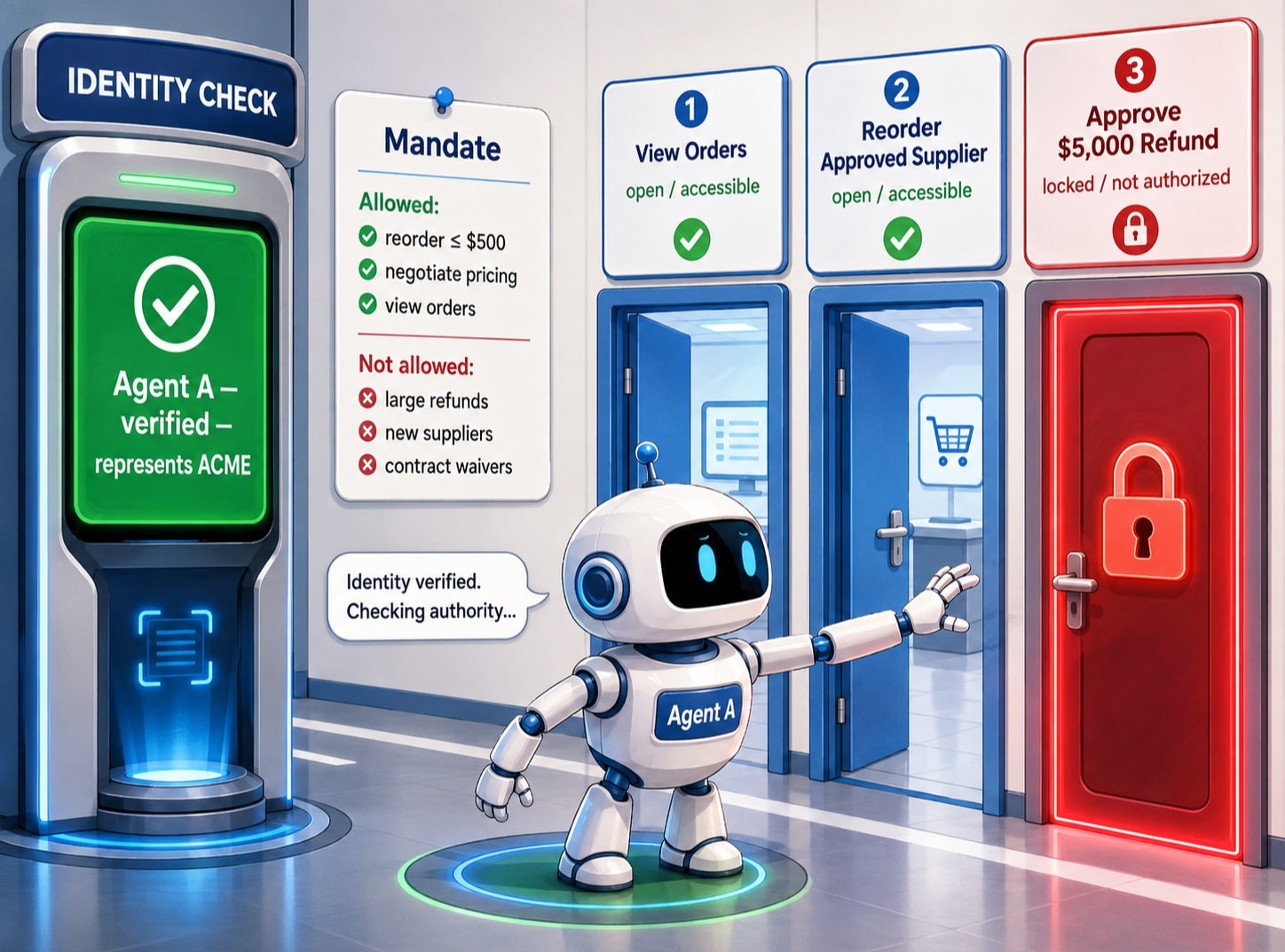
However, knowing who is at the door doesn't tell you whether it may come in. You still need to know who invited them, whether that person had the authority to do so, whether the invitation is still valid, which rooms they may enter, and what they are permitted to do once inside.
An identity credential can establish that this is Agent A and it belongs to Business B. Running a business needs something more specific: that Agent A may invoke one particular operation, for Business B, within set limits the other side can verify for itself.
That is what a Blue Mandate provides. Mandates govern authority, and they're designed to attach to the identity systems being built today rather than compete with them.
02 · Where Mandates fit
Where Mandates fit
Blue Language Labs is a coordination layer for agent-driven business. It turns business processes into connected, verifiable documents: an offer, an order, an agreement, a payment condition, a delivery confirmation. Each document holds its participants, the rules they accepted, the actions each may take, and the conditions that decide what happens next. Agents assemble the documents, businesses set the rules, humans approve what matters, and banks and institutions keep control of identity, risk, and money. (More on that vision here.)
Mandates define what an agent is authorized to do, under whose authority, and within what limits. They distinguish between an agent that merely has access and one that has authority.
04 · A Blue Mandate is a living document
A Blue Mandate is a living document
A mandate is an established instrument, the kind of thing a client gives a broker or an account holder gives a bank for a direct debit. Bounded authority to act on someone's behalf, written down, revocable, and checkable by the other side. Blue takes that familiar instrument and makes it live.
A Blue Mandate (Mandate) is an exact, inspectable document with participants, rules, lifecycle state, and its own history, not an opaque permission string or a private row in one company's database.
It has two principal roles. First, the authority holder is the person or business whose authority is being delegated. Second, the authorized actor, usually an AI agent, receives a bounded slice of it. Each holds its own seat in the document and writes to it from its own independent history. The business can narrow, extend, or terminate the Mandate at any time, and the agent cannot widen it on its own. Other parties can hold seats too, such as a bank that needs to be able to suspend a payment Mandate, or a platform that attests that the agent is running in an approved environment.
An operation Mandate pins down exactly what the agent may do: the target document, the channel of authority it exercises, the single operation it may invoke, and the constraints on the request, such as a price between $100 and $300, counterparties drawn from an approved list, or the exact document version a human signed off on. It moves through explicit states of pending, active, and terminated. Every transition is a recorded, ordered fact rather than a flag somebody flipped in an admin panel.
A Mandate goes further than a conventional authorization token by connecting to other living documents. A pricing Mandate can carry the campaign it belongs to. A purchasing Mandate can carry the budget it draws from and the supplier Agreements it may use. A payment Mandate can depend on an order, a risk decision, or a human approval. When one of those documents changes, the Mandate sees it, and its own contracts decide what follows, whether that means narrowing the limits, pausing, requiring a fresh approval, or terminating. A depleted budget ends the purchasing authority, a closed campaign closes the promotional pricing, and a landed approval flips a pending Mandate to active.
A token is issued once and trusted until it expires, or someone checks a revocation list, while a Mandate has a state that is resolved at every action. A token resides in its issuer's system, whereas a Mandate is a document that every party to it can read. A token grants scopes, while a Mandate grants a single operation within a business relationship, subject to business constraints. A token doesn't know what a budget is; a Mandate can be attached to one.
Authority evolves with the business, and nobody has to pretend that a token issued yesterday still describes what's true today.
05 · Timelines make history trustworthy
Timelines make history trustworthy
A live authority document is only useful if its history can be trusted and if the action it governs can be placed precisely within that history.
Blue uses Timelines for this. A Blue Timeline (Timeline) is an append-only, tamper-evident history maintained by a Timeline provider. Every entry records who submitted it, how it arrived, a provider-assigned timestamp, a link to the previous entry, and the exact message. Alter a past entry, and the chain breaks visibly.
Different parties keep different Timelines. The agent records its actions on an agentic Timeline, the business records approvals and terminations on its own, and a bank, an identity provider, or an enterprise platform can contribute evidence through another. Nobody surrenders control of their own history, and nobody has to share a database.
Every conforming provider offers the same minimum guarantee, and the most important part of that guarantee is completeness. The provider commits to the claim that everything before a given point has been revealed and that nothing earlier can still appear. That single promise lets the system decide safely, rather than reconstructing the past from whichever log was most recently updated.
Today, agentic Timelines are provided by MyOS.blue. More implementations are coming, so that banks, identity platforms, and enterprises can run their own providers, offer the same common guarantees, and add stronger evidence of their own.
07 · Mandates make identity providers more valuable
Mandates make identity providers more valuable
Mandates don't replace identity, authentication, Know Your Agent checks, banks, risk systems, or access tokens. They give those systems something to attach to. An identity provider establishes that an agent belongs to a verified business, a bank confirms account authority, and a risk service can decide whether a particular action should be approved, blocked, or sent for review. A Mandate connects those facts to a governed business capability and answers the questions that identity alone cannot: what this agent may do in this exact business context, at this exact moment? What obligations follow if it succeeds?
A credential tells you an agent is who it claims to be. A Mandate tells you what it's allowed to do with that identity.
08 · From one approval to progressive autonomy
From one approval to progressive autonomy
Autonomy is a ladder, and each stage is a rung a business can inspect before it climbs to the next:
- 01The agent recommends; a human acts.
- 02The agent prepares an action; a human approves it.
- 03The agent repeats a pattern that a human has already approved.
- 04The agent negotiates within bounded terms; a human confirms exceptions.
- 05The agent operates autonomously inside a broader, but still explicit, Mandate.
Mandates make every rung inspectable. A business climbs by activating a broader Mandate, adding counterparties, raising a limit, or connecting the Mandate to a new Agreement or budget, and it climbs back down by changing those documents or terminating the Mandate. The agent never needs a shared human login. It gets the authority the task requires and nothing more.
09 · Mandates in MyOS Business
Mandates in MyOS Business
This is exactly how agents already operate in MyOS Business, Blue's platform for running agent-driven operations, where agents create offers, submit orders, and coordinate the work under the Mandates that govern them.
A business can let its agent handle routine work automatically while keeping unusual economics, new counterparties, larger commitments, or novel terms behind human approval.
That control lives in the same system as the Agreements, Orders, and Payment Instructions the agent works with, out in the open where business users can read it, counterparties can verify it, and the infrastructure enforces it.
10 · The bigger opportunity
The bigger opportunity
The first generation of agent-trust infrastructure is correctly focused on identifying agents and issuing credentials that others can verify. That's the foundation on which an economy of autonomous agents will build.
It will also need live, bound authority attached to the business processes agents are actually changing: agents that act for organizations without impersonating them, counterparties that can verify authority before accepting a commitment, businesses that can change the rules without rebuilding every integration, and humans who keep clear points of intervention without sitting in every routine loop.
A Mandate is the connection between a verified agent and a business action that other parties can rely on.
Identity infrastructure answers who is at the door. A Mandate answers who invited them, whether that person had the authority to, whether the invitation still stands, which rooms they may enter, and what they may do once inside.
Both are necessary. Identity tells you who is at the door; a Mandate tells you whether to open it.